
- When does ‘different’ stop being different?
- When is a norm due for a revision?
- When do we agree that something prevalent is being excluded?
If neurodivergence affects 15-20% of the population, we’re not discussing exceptions; we’re discussing a variation within the human norm. The question isn’t whether this is real; the question is why our systems still treat a fifth of humanity as defective or ‘a-typical’.
The numbers are consistently repeated across multiple credible sources. Nancy Doyle’s research in the British Medical Bulletin places the estimate at 15-20% globally. The CIPD in the UK confirms that one in five people is neurodivergent. YouGov’s US data shows 19% self-identify as such. The EU-OSHA reports the same: one in five workers operate with a different cognitive architecture, encompassing ADHD, Autism, Dyslexia, Dyspraxia, Tourette’s, and other conditions that fall outside the assumed neurotypical norm.
At this scale, the term ‘divergent’ seems to be up for debate. We are not dealing with statistical outliers. We are dealing with a substantial minority that our systems have consistently failed to recognise, accommodate, or leverage.
Yet the cultural response to this reality remains contradictory. On the one hand, we observe a continuous rise in reported diagnoses. On the other hand, we meet this rise with scepticism: “We didn’t have this before, so why now all of a sudden everyone has ADHD?” The framing dismisses neurodivergence as a cultural fad, a convenient label, or evidence of declining resilience.
This is not only a medical debate. It is also a governance failure; a systemic inability to accept that a fifth of the population could operate on a fundamentally different cognitive architecture without treating it as pathology. The paradox is stunning: we observe a rising tide of recognition, yet we simultaneously reject the idea that this recognition is legitimate.
At what point do we stop measuring 20% of humanity against a fictional default and start asking whether the default itself was ever universal?
The Evidence of the Nerve
This contradiction is not abstract. It manifests in concrete, measurable ways across institutions, workplaces, and public discourse.
Consider the response when the topic surfaces publicly. Lecture halls fill to capacity, such as Saskia Schepers’ talk at the TU/e Blauwe Zaal, organised through Studium Generale and Stichting Donatues. The room was packed. Weeks earlier, the EHV Innovation Cafe hosted two speakers on the same subject, with a similar impact. The pattern is consistent: wherever the conversation opens, the demand appears.
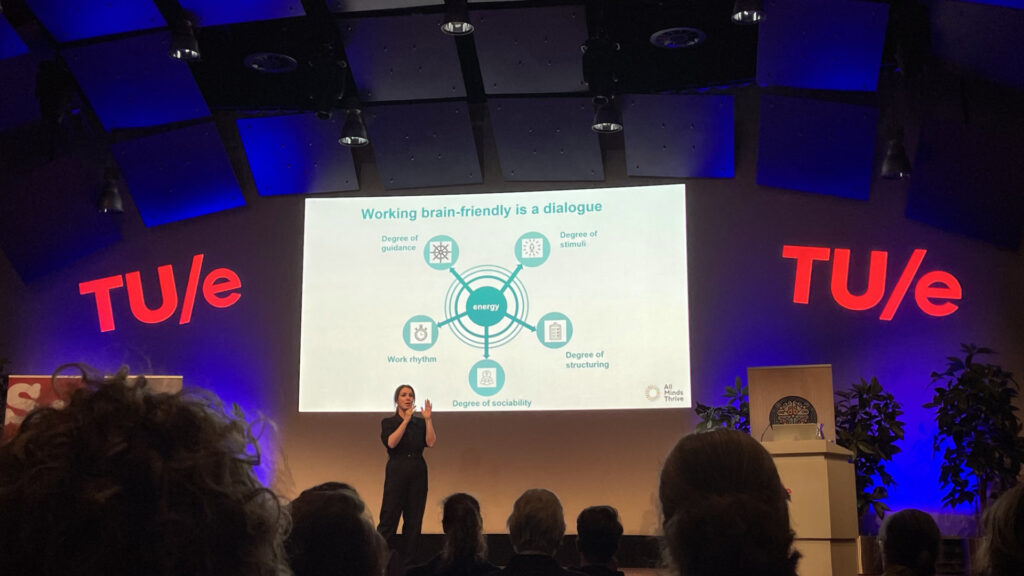
And it’s not passive interest. When individuals share their own experiences or raise questions about neurodiversity, the response is immediate and visceral. Inboxes flood. Connection requests stream in. Conversations that had been waiting to happen suddenly erupt. The reaction isn’t polite curiosity, but rather recognition.
This is particularly visible in environments like Brainport Eindhoven, where neurodiversity intersects with other forms of difference. Here, cognitive variation compounds with cultural diversity, multiple languages, and the intense pressure of a high-stakes innovation economy. The ecosystem depends on complex problem-solving, rapid adaptation, and creative thinking; precisely the areas where neurodivergent traits can be a strategic advantage. Yet the infrastructure to support, understand, or even acknowledge this reality remains fragmented at best, absent at worst.
The nerve isn’t individual. It’s systemic. And the scale of the response suggests that the need for understanding isn’t niche. Instead, it’s mainstream and profoundly unmet.
So why the persistent disconnect between prevalence and recognition?
- Recognition
The data seems to resolve the debate decisively. Neurodivergence may not be increasing, but our ability to recognise it certainly is. Rising diagnosis rates represent an epidemic of awareness, not occurrence. Multiple converging factors explain this phenomenon, and understanding them is essential to separating perception from reality.
- Diagnostic Criteria Changes
The revision of the DSM-5 in 2013 fundamentally broadened the diagnostic net. It allowed for the co-diagnosis of Autism and ADHD, which had previously been considered mutually exclusive. It folded previously distinct labels (such as Asperger’s Syndrome and PDD-NOS) into the broader Autism Spectrum. These changes didn’t create new cases; they reclassified existing ones and made visible what had always been present but unrecognised under narrower criteria.
- Expanded Awareness
Social media, public figures sharing their experiences, and widespread educational campaigns have normalised conversations about neurodiversity. This cultural shift has led to greater self-referral and professional screening. People who might once have dismissed their struggles as personal failings now seek assessment.
- Better Identification of Overlooked Groups
Diagnostic criteria were historically based on presentations in young boys. This led to the systematic under-identification of girls and women, people of color, and individuals who developed effective masking strategies. The current surge in adult diagnoses — particularly among women — is not evidence of a new phenomenon. It is the correction of a longstanding diagnostic blind spot.
- Screening Programs
In 2007, the American Academy of Pediatrics recommended universal autism screening for all children. Similar initiatives have expanded screening for ADHD and other conditions. More systematic screening naturally results in more identified cases.
- Incentive Structures
In many systems, a formal diagnosis is required to access essential support: Individualised Education Plans (IEPs), workplace accommodations, disability benefits, or therapeutic services. This creates a practical incentive to seek diagnosis, not because the underlying condition is new, but because the label unlocks necessary resources.

The critical evidence comes from longitudinal studies. A Swedish twin study analysing data from 1993 to 2001 found no overall rise in underlying ASD-related symptoms in adolescents and young adults, despite the surge in reported diagnoses. For ADHD, the increase in symptoms was minor and limited primarily to girls, consistent with the hypothesis that previous diagnostic frameworks systematically missed female presentations.
The conclusion seems unambiguous: the prevalence of neurodivergence has remained stable. What has changed is our clinical and societal lens. We are finally seeing what was always there.
The “problem” is not that 20% of people are neurodivergent. The “problem” is that our systems spent decades failing to see them, and that even now, recognition is treated with suspicion rather than as long-overdue correction.
Beyond the Stereotypes
Society’s image of neurodivergence remains locked in dramatic, easily televised tropes: the Rain Man savant with extraordinary memory, the visibly ticcing individual with Tourette’s, the hyper-visual autistic genius solving complex equations. These representations are a profound disservice to the daily, lived reality of the majority of the neurodivergent population.
This is not about the exceptional or the theatrical. It is about the invisible: the laterally wired minds that function faster, process with greater granularity, and connect seemingly disparate concepts into novel insights. It is about brains that are often described, both by themselves and their surroundings, as “too much“.
For many, this difference is managed through intense, exhausting masking, just to be perceived as “normal”. The performance requires monitoring tone, suppressing stimming, forcing eye contact, translating internal processing into expected social scripts, and suppressing the urge to interrupt with a fully formed thought before the other person finishes speaking. This is not occasional code-switching; it is a sustained, daily effort that research confirms leads to significantly higher rates of burnout. Studies show that up to 50% of neurodivergent professionals report burnout, a rate far exceeding that of their neurotypical peers. The bore-out phenomenon — chronic under-stimulation in environments designed for the neurotypical majority — compounds this effect, creating a double bind where both too little and too much demand become sources of systemic stress.
The goal is not the label. The goal is to understand the operational manual for a system that works differently. Whether we use diagnostic terminology or simply acknowledge “they think differently”, the impact on performance, wellbeing, and team dynamics remains real.
This is not a defect. It is a different operating system running in an environment designed for the default architecture. The friction occurs not because the system is broken, but because the environment assumes a uniformity that does not exist. The gap between the operating system and the environment is where both stress and talent waste occur.

The Infrastructure Gap
If 20% of society operates with fundamentally different cognitive architecture, the systemic response should be clear: build infrastructure that accommodates, leverages, and nurtures this variation. Yet when you look for it — a central hub, a practical resource, a place to go for answers — you find a void.
Where does an employer go to design a more cognitively inclusive workplace? Where does a teacher go for pragmatic classroom strategies that don’t require a medical diagnosis? Where do parents go for non-therapeutic, evidence-based insights? Where do institutions turn when they want to support neurodivergent individuals without forcing them through a lengthy, often stigmatising diagnostic process?
The landscape is fragmented:
- Specialist consultancies often focus narrowly on employment pathways for (for instance) autistic professionals, primarily in tech. Valuable, but not broadly accessible.
- Academic research initiatives, such as the NWO projects developing workplace toolboxes, remain in the creation phase; promising but not yet operational.
- Awareness foundations like Stichting Donatues do essential work raising visibility and sparking conversation, but they are not structured as practical hubs for day-to-day operational guidance (yet).
What is missing is a “Cognitive Diversity Enablement Hub“: a single, accessible, evidence-based resource for diverse stakeholders (employers, educators, parents, policymakers) that offers concrete, actionable guidance outside the medical framework.
This gap is particularly acute in environments like Brainport Eindhoven. Here, neurodiversity is compounded by the intersection of international cultures, multiple languages, and the intense pressure of a high-stakes innovation economy. The region’s competitive advantage depends on its ability to attract and retain top talent, solve complex technical challenges, and sustain a culture of relentless innovation. Yet the very cognitive diversity that could fuel this advantage (the lateral thinkers, the pattern recognisers, the detail-obsessed, the systems thinkers) often cannot find traction in environments that assume a neurotypical default.
Organisations in this ecosystem cannot afford to search through mountains of well-intentioned but fragmented information. The absence of a centralised, practical knowledge infrastructure represents a problematic form of human debt; a cost that resides invisibly in lost talent, unrealised innovation, and the burnout of individuals trying to navigate systems that were not designed for them.
The question is not whether the need exists; the evidence is overwhelming. The question is whether and how we will respond to it.
Defect or Design?
We must fundamentally reframe the conversation. What if neurodivergence is not a defect, but a systemic adaptation, a form of beneficial variation, that is typical in nature for resilience and robustness?
Nature does not create 20% design flaws. It creates variation for survival, adaptability, and competitive advantage. Think: cognitive, biological, cultural. Monocultures are fragile; diversity creates resilience.
The research supports this reframe:
- Innovation and Problem-Solving
Studies consistently show that cognitively diverse teams, including neurodivergent professionals, outperform neurotypical groups in complex problem-solving by 20% to 30%. The diversity of processing styles creates a richer solution space, with the benefits of differences between linear and lateral, detail-focused and big-picture, rapid and deliberate.
- Productivity and Precision
Companies with intentional neurodiversity programs, such as Hewlett Packard Enterprise, SAP, and JPMorgan Chase, have reported teams being 30% more productive in roles requiring sustained attention to detail, such as software testing and data analysis. The reason is straightforward: pattern recognition, exceptional memory, and sustained focus on granular detail are documented strengths of many neurodivergent individuals.
- Creative and Systematic Thinking
The strengths are not uniform, since neurodivergence is not a single profile, but documented traits include systematic thinking, creative problem-solving, innovative approaches, and the ability to see connections that others miss. These are precisely the skills demanded by today’s most complex technological and societal challenges.

This is not a purely optimistic view. Real challenges remain. Unemployment rates for autistic adults are estimated at 30% to 40%, which is significantly higher than for other “disability groups” and far exceeding the general population rate of around 4%. An estimated 85% of autistic adults are either unemployed or significantly underemployed relative to their skills. Mental health comorbidities are common: approximately 33% report anxiety, 17% report depression. The toll of masking, navigating ill-fitting environments, and repeated experiences of exclusion or misunderstanding is real and measurable.
But the question we must ask is not “What is wrong with them?”. The real question is: “What is wrong with systems designed for 80% of the population that cannot accommodate the unique talents of the other 20%?”.
The defect is not in the people. The defect is in the system design.
Working With, Not Against
We owe it to society and to our economies to work with this reality, not against it. The necessity is magnified in environments like Brainport Eindhoven, where informal dynamics and implicit communication norms that neurotypical individuals rely on become counterproductive when operating across linguistic and cultural divides. What works as a coping mechanism in a homogenous environment fails in a diverse one. Without intentional system design, with a focus on clarity in communication, explicit structure, and accommodation for different processing speeds, the ecosystem risks losing the very talent it needs most.
The cost of neglect is already visible:
- Talent Loss
High unemployment and underemployment rates among neurodivergent individuals represent a massive waste of human capital. These are not individuals lacking skills; they are individuals whose skills cannot find traction in environments designed for a different cognitive profile.
- Burnout Epidemic
Fifty percent of neurodivergent professionals report burnout. The cognitive tax of constant masking, combined with environments that either under-stimulate or overwhelm, creates unsustainable conditions.
- Productivity Loss
Organisations that fail to create cognitively inclusive environments miss documented productivity gains of up to 30% in roles suited to neurodivergent strengths.
- Innovation Loss
The cognitive diversity that drives 20-30% improvements in complex problem-solving remains unrealised in organisations that cannot accommodate variation.
- Competitive Disadvantage
For regions like Brainport, where innovation is the economic engine, the inability to fully leverage cognitive diversity is a strategic liability.
Accommodation is no longer optional. It is a strategic necessity tied directly to economic resilience, innovation capacity, and competitive advantage. The human debt incurred by ignoring this reality accumulates invisibly until it becomes a structural constraint on growth.
The shift required is straightforward: stop trying to fix the person. Start fixing the environment.

The Call
The need is clear. We must build a practical “Cognitive Diversity Enablement Hub”.
This cannot be another fragmented initiative or awareness campaign. It must be a comprehensive, accessible, evidence-based resource designed to serve the practical needs of multiple stakeholders.
What this hub must be:
- Accessible Without Diagnosis – It must operate outside the medical model. Individuals should not need a formal diagnosis to access information, guidance, or support. The goal is enablement, not gatekeeping.
- Evidence-Based – It must move beyond well-meaning vloggers, self-declared experts, and anecdotal advice. The foundation must be vetted research, clinical insight, and pragmatic knowledge.
- Practical in Focus – Employers need to know: “How do I design a more inclusive workplace?”. Teachers need to ask: “How do I support this student effectively without requiring a label?”. Parents need guidance: “Where do I start?”. Institutions need frameworks: “How do we integrate cognitive diversity into our systems from the outset?”.
- Regionally Attuned – The Brainport context is unique. Neurodiversity intersects with international cultures, multiple languages, high-tech demands, and intense innovation pressure. A generic solution will not work. The hub must address the specific convergence of challenges in this ecosystem.
What this enables:
A single point of contact for practical questions. A repository of tools, frameworks, and case studies. A bridge between academic research and operational reality. A resource that institutions, companies, and individuals can trust to provide clarity rather than add to the noise.
The demand is visible. Lecture halls fill when the topic is raised. Inboxes flood after a single public mention. Connection requests stream in. The Ehv Innovation Cafe speakers, the response to Saskia Schepers’ work, the reaction to Stichting Donatues’ initiatives, all point to the same conclusion: the nerve has been struck. The recognition is happening.
Despite good intentions and valuable fragmented efforts, the comprehensive infrastructure does not yet seem to exist. The time seems right to design systems that recognise cognitive diversity as part of the norm and integrate it into governance, education, and corporate talent frameworks from the start.
The 20% Question
If this reality rings true for one in five colleagues, one in five students, one in five family members, the term ‘divergent’ becomes an outdated misnomer. It maintains the fiction that there is a single, perfect ‘norm’ against which all others must be measured and found wanting.
The label itself is a governance artefact: a categorisation system that treats substantial human variation as deviation. At 20%, we are not discussing edge cases. We are discussing a predictable, stable distribution of cognitive architecture within the human population.
Must we keep pointing this out until every last person agrees? Or can we simply begin the work of building systems that acknowledge this cognitive variation from the outset?
The flood of responses after any public acknowledgement of this topic proves that recognition is already happening. The demand exists.
The only remaining divergence is in our collective commitment to act on this recognition. To redesign environments rather than pathologise individuals. To build infrastructure rather than rely on ad hoc accommodations. To leverage cognitive diversity as a strategic asset rather than treat it as a problem to be managed.
Years of circling these questions from different angles — critiques of workplace dysfunction, explorations of motivation, examinations of cultural and linguistic divides, analyses of the human cost of scaling — have all led here. The pattern was always visible. The lens simply needed to be sharpened.
Perhaps the real ‘defect’ is not in how 20% of brains work, but in the 80% of systems that were never designed to capture their unique potential. The question is no longer whether we see the problem. The question is whether we will build the solution.

PS: On Bias and the Personal Lens
This article is the direct result of a social media post I made after attending Saskia Schepers’ lecture on neurodivergence at the TU/e (Technical University in Eindhoven, the Netherlands). I wrote about having recently received an ADHD diagnosis, not because the label itself matters, but because it fit the context of the conversation that followed with Saskia, the organisers, and a few attendees.
The response was immediate and overwhelming: flooded inboxes, connection requests, and dozens of private messages from people sharing their own experiences or asking where to find the practical support I hinted at by asking for a “loket”.
That reaction is what prompted this piece. But it also means I must acknowledge: I am not a neutral observer. I have a stake in this question. My own journey into understanding neurodivergence (both before and after diagnosis) inevitably shapes how I see the infrastructure gap, the talent waste, and the systemic cost of designing for uniformity.
I have tried to ground this argument in evidence rather than experience, in data rather than anecdote. The 15-20% prevalence figure, the Swedish twin studies, the productivity gains in neurodiversity programs, the unemployment rates; these are not my story, rather, they are the pattern. But I cannot claim to see that pattern without bias.
If anything, that bias and the apparent need expressed in the many reactions make the call more urgent. I am actively looking for those who have already spent time on building such a “loket”, or who can help others find their way in this topic. If this resonates with you — whether as an employer, educator, policymaker, or fellow traveler in this space — reach out and share your thoughts, feedback, and/or contact details.

References & Further Reading
The following sources provide prevalence data, workplace insights, and further reading for those who want to explore neurodivergence in greater depth.
Prevalence & Epidemiology
* Yale Center for Dyslexia and Creativity. Prevalence estimates from longitudinal studies. Summary: Longitudinal research led by Sally Shaywitz shows dyslexia affects ~20% of the population (1 in 5), equally across genders, with schools often under‑identifying cases.
* Salari, N. et al. (2023). The global prevalence of ADHD in children and adolescents: a systematic review and meta-analysis. Italian Journal of Pediatrics, 49(48). Summary: Meta‑analysis of 61 studies found ADHD prevalence at 7.6% in children and 5.6% in adolescents, with diagnostic criteria influencing rates.
* Popit, S. et al. (2024). Prevalence of attention-deficit hyperactivity disorder (ADHD): systematic review and meta-analysis. European Psychiatry, 67(1), e68. Summary: Across 103 studies, prevalence estimates vary by methodology: ~1.6% in registry data, ~5% in surveys, ~4–5% in clinical studies, highlighting diagnostic variability.
* CDC (2025). Data and Statistics on Autism Spectrum Disorder. Autism and Developmental Disabilities Monitoring (ADDM) Network. Summary: Latest prevalence: 1 in 31 (3.2%) U.S. children aged 8 years; boys ~3.4× more likely to be diagnosed, with improved identification across racial and ethnic groups.
* Sacco, R. et al. (2022). The Prevalence of Autism Spectrum Disorder in Europe. IntechOpen. Summary: Meta‑analysis estimates ASD prevalence at ~1.4% in European population studies, with diagnostic disparities across regions and socioeconomic groups.
* Lauritsen, M. et al. (2016). Urbanicity and Autism Spectrum Disorders. Journal of Autism and Developmental Disorders. Summary: Danish cohort study found ASD risk up to 2.5× higher in urban areas, linked to diagnostic infrastructure and assortative mating.
Workplace & Policy Reports
* Doyle, N. (2020). Neurodiversity at work: a biopsychosocial model and the lines of best fit. British Medical Bulletin, 135(1), 108–123. Summary: Synthesises epidemiological data, proposing that 15–20% of the population meet criteria for neurominorities, and advocates for biopsychosocial workplace models.
* EU-OSHA (2025). Neurodiversity in the workplace. Summary: Notes that ~1 in 5 people are neurodivergent, highlighting the need for inclusive occupational safety and health practices.
* CIPD (2024). Neuroinclusion at work report 2024. Summary: Confirms ~20% prevalence; shows that only 60% of organisations focus on neuroinclusion, with disclosure gaps among employees.
* Tech Talent Charter (2024). Diversity in Tech Report. Summary: Employers estimated 3% neurodivergent staff, but 50% of tech workers self‑identified as neurodivergent in anonymous surveys, revealing a major disclosure gap.
* Bayliss, K., et al. (2023). The Neurodiversity Concept in the Tech Sector. Summary: Examines how high‑tech clusters in Europe (UK and Germany) have become “accidental sanctuaries” for neurodivergent talent, linking urban concentration and diagnostic infrastructure to high self‑identification rates.
Selected Books on Neurodiversity
Workplace & General Neurodiversity
* Saskia Schepers (2024). When All Minds Thrive: The Competitive Advantage of Neurodiversity in the Workplace. Summary: Explores how neurodivergent talents (autism, ADHD, dyslexia, giftedness, high sensitivity) can be leveraged in organisations.
* Saskia Schepers (2023). Als alle breinen werken. Summary: The first Dutch book on neurodiversity in the workplace, advocating for “brain‑friendly” environments.
* Victoria Honeybourne (2019). The Neurodiverse Workplace. Summary: Practical guide for employers, covering autism, ADHD, dyslexia, Tourette’s, and more.
* Stephen Harrison (2025). Understanding and Supporting Neurodivergence. Summary: Strengths‑based handbook covering ADHD, dyslexia, dyspraxia, sensory processing disorder, and more.
Autism & Broader Neurodiversity
* Steve Silberman (2015). NeuroTribes. Summary: Landmark history of autism, advocating for acceptance and inclusion.
* Temple Grandin (2013). The Autistic Brain. Summary: Combines neuroscience with lived experience, explaining autistic cognition.
* Barry M. Prizant (2015). Uniquely Human. Summary: Challenges deficit‑based views of autism, focusing on empathy and support.
* Devon Price (2022). Unmasking Autism. Summary: Explores masking in autistic individuals, offering strategies for authenticity.
* Jenara Nerenberg (2020). Divergent Mind. Summary: Focuses on women and underrepresented groups in neurodiversity.
* John Elder Robison (2007). Look Me in the Eye. Summary: Memoir offering insight into living with Asperger’s.
ADHD / ADD
* Edward M. Hallowell & John J. Ratey (1994/2011). Driven to Distraction / Delivered from Distraction. Summary: Classic works reframing ADHD as a lifelong condition with both challenges and strengths.
* Tamara Rosier (2021). Your Brain’s Not Broken. Summary: Practical strategies for adults with ADHD, focusing on emotional regulation and executive function.
* Rebecca Schiller (2021). A Thousand Ways to Pay Attention. Summary: Memoir blending ADHD diagnosis with reflections on creativity and resilience.
Synesthesia
* Richard E. Cytowic (1993). The Man Who Tasted Shapes. Summary: Seminal account of synesthesia as a neurological reality.
* Patricia Lynne Duffy (2001). Blue Cats and Chartreuse Kittens. Summary: Personal narratives from synesthetes, showing how sensory blending shapes perception.
* Julia Simner & Edward Hubbard (eds., 2013). The Oxford Handbook of Synesthesia. Summary: Comprehensive academic reference covering genetics, neuroscience, and cultural aspects of synesthesia.
Tourette Syndrome & Tic Disorders
* Tourette Association of America Reports (2022). Survey Reports. Summary: Surveys highlight underdiagnosis, co‑occurring conditions, and workplace challenges.
https://www.linkedin.com/pulse/20-question-when-divergent-becomes-normal-roland-biemans-n348e
Comments are closed