
How a Police Campus Became a Mirror of Administrative Drift
(September, 2025)
There are moments when a map tells more than a plan. When the lines drawn across a cityscape begin to resemble the contours of a deeper story. One not of infrastructure, but of influence. The proposed police campus at Land Forum in Meerhoven is such a map. It traces not just a relocation, but a choreography of decisions, omissions, and quiet escalations.
Low-Friction Entry Point
The first seeds were sown in 2013, when the Dutch government initiated a sweeping reorganization of the national police. The mantra was consolidation: fewer scattered bureaus, more regional hubs, and facilities capable of training, logistics, and riot deployment. By 2016, Eindhoven had been designated as one of these anchor points. Its central location in Noord-Brabant, combined with airport proximity and urban growth, made it an obvious candidate. The Mathildelaan bureau, with its outdated cell complex and fragmented layout, was formally judged unfit for the future.
The ambition was modest at first: replace Mathildelaan with a consolidated base where existing departments could work side by side. But in the years that followed, “replacement” morphed into “expansion.” Training grounds were added to the brief. Riot units (M.E., short for Mobiele Eenheid) were promised space. By the time early site searches began, the project had become less about relocation and more about transformation.
Black Box of Selection
Seventeen locations were considered. Three shortlisted. One chosen. Yet the criteria, the comparative logic, the civic voice; all were folded into silence. No public matrix. No transparent scoring. No deliberative process that allowed residents to weigh in meaningfully. The narrowing was administrative, not democratic.
“We were told Land Forum was the best fit. But we were never shown why. Trade Forum had better traffic access and overflow parking. Why was it dismissed?”
— Resident, Meerhoven (public meeting, 2023)
The municipality’s response was procedural: the ‘College van B&W’ had made its selection based on planological fit and operational needs. But the community saw something else: a pattern of selective reasoning, where objections were acknowledged but not integrated, and alternatives such as Trade Forum were dismissed without comparative substantiation.
In 2020, engagement began. ‘Klankbordgroep’ meetings, newsletters, and Q&A sessions were held. Residents raised concerns about traffic, scale, and environmental impact. But even as these sessions unfolded, the project’s scope was quietly expanding. What was initially framed as “housing” for police staff became a full-spectrum campus, with daily presence projected at over 2500 individuals, including students and visitors.
“We were engaging with a moving target. Every time we asked for clarity, the project had grown.”
— Meerhoven Residents’ Association (Meerhoven.nl, 2023)
“Urgency” as Political Lock-in
The turning point came in May 2021. Over 98% of consulted residents formally requested a ‘leefbaarheidsonderzoek’ (a quality-of-life study) to assess the impact of the proposed development. The municipality declined. Instead, it offered urgency: an alleged police ultimatum to relocate elsewhere if Land Forum was not approved.
“The College acknowledges the urgency expressed by the police, but does not provide documentation of the alleged ultimatum.”
— Raadsinformatiebrief, June 2021 (meerhoven.nl)
This moment crystallized the administrative rupture. The principle decision to proceed was granted without the requested study, and without substantiating the threat that justified bypassing it. The municipality had shifted from feasibility to execution, and the community was left with procedural residue.
In December 2021, the Sliffertsestraat rerouting was approved. In the plans, the road was moved westward, closer to residential zones, to create a sealed terrain for police operations. Residents objected, citing traffic, access, and loss of landscape buffers. The municipality framed the decision as a technical necessity. But spatial alternatives were never publicly explored.
“The rerouting was presented as inevitable. But inevitability is not the same as necessity.”
— Local architect, spatial planning forum (2022)
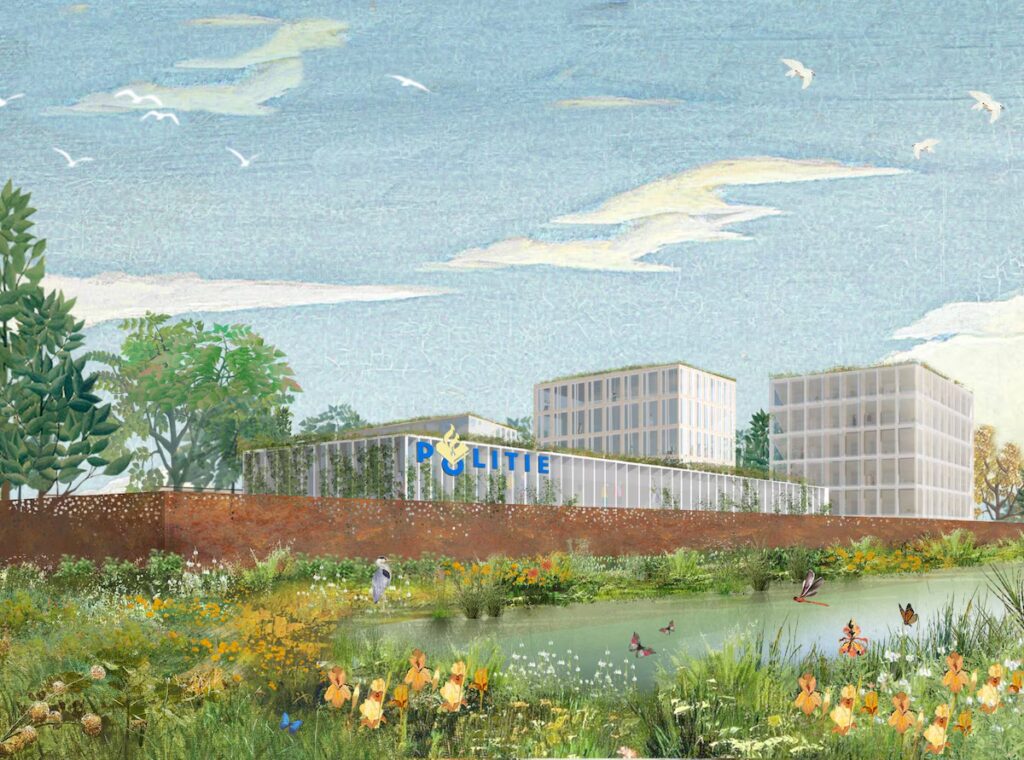
From Housing to Fortress
Design work continued. A masterplan was published in late 2023, revealing the full scale and intensity of the campus. Training grounds, cell blocks, logistics zones, and reserved space for riot units. The visual story was stark; and it was far removed from the initial framing of “housing.”
“This is not a relocation. It’s a transformation. And it was never framed as such.”
— Civic researcher, Eindhoven (2024)
On May 30, 2023, the ‘bestemmingsplan’ was adopted by the Municipal Council. Despite extensive objections, the plan passed with a 26–16 vote. Residents filed appeals with the ‘Raad van State’, arguing that the plan violated principles of proportionality and subsidiarity, and that alternatives were insufficiently considered.
“The appellants argue that the Bestemmingsplan violates principles of proportionality and subsidiarity, citing inadequate traffic impact studies and failure to consider alternative sites.”
— Raad van State case register (2024)
Legal proceedings began. Hearings were scheduled. Procedural rulings published. And then, in 2025, a final act: ‘onteigening’. Local media reported that the municipality was preparing expropriation of remaining pieces of land to secure the 7-hectare site.
“Onteigening dreigt voor Eindhovense huiseigenaren wegens plan voor megapolitiecomplex.”
— Eindhovens Dagblad, September 2025 (ed.nl)
The legal machinery moved. The map tightened. The story nearing its end.
Architecture of Accountability
But this is not just about land. It is about method. About how obfuscation becomes operational. How public trust erodes not through confrontation, but through omission. And how a community, when denied clarity, must become its own cartographer to find out what map the local government secretly has been drawing.
The Meerhoven case is not unique. But it is instructive. It shows how administrative drift can mask strategic escalation. How engagement can be used as a proxy for consent. And how the language of urgency can override the architecture of accountability.
As of this writing, the appeals remain active. The land acquisition process continues. And the community watches. Documenting, questioning, resisting. Not out of opposition, but out of principle. Because when the map no longer reflects the terrain, it is not the terrain that must change. It is the map itself.
| Date / Period | Decision / Event | Significance, changes, objections, growth, alternatives considered / rejected |
|---|---|---|
| 2013 | Reform to ‘Nationale Politie’ | The reorganisation of police forces nationally led to consolidation ambitions and larger, integrated facilities. The existing Mathildelaan location in Eindhoven was no longer considered suitably modern / scalable. |
| Late 2018 – Early 2019 | Initial location scan & size baseline | Eindhoven + police begin exploring suitable locations for consolidating police functions. Among ~17 candidate sites considered, then narrowed to ~3. Land Forum emerges as a preferred option. Municipal summaries state that among “criteria” were reachability, site size, environmental impact, planological fit. |
| Dec 2019 | Formal location decision: Land Forum | The municipal executive (college) decides to prefer Land Forum as the site for new police housing. The municipal site describes that further alternatives are not being explored post-decision. |
| Dec 2019 (public messaging / “mogelijke huisvesting”) | Initial capacity communicated | At that time, the project was framed around ~1,250 politie medewerkers (employees) plus cell / training functions; the plan was, in municipality / project site language, more modest in scale. |
| 2020 | Early public engagement, ‘klankbordgroep’ | The municipality and police hold meetings, solicit reactions, gather suggestions and concerns from residents. Some residents question scale, traffic, and ask for alternatives. |
| Oct–Nov 2021 | Consultation on Sliffertsestraat variants | A study bureau (ZET) holds ~134 conversations with residents, users, passersby to gather inputs on whether to route Sliffertsestraat east or west of the plot. These inputs feed into the decision on re-routing. |
| Dec 2021 | Decision to ‘verleggen’ Sliffertsestraat to west side | The college (B&W) decides on the west alignment, after weighing traffic, environmental, financial and resident input. This is a substantive design shift that has visible neighborhood impact. |
| Feb 15, 2022 | Alternative proposal: Trade Forum site proposed by residents / groups | In a public letter, residents propose that the Trade Forum site (behind P+R / Hotel Campanile area, near N2/A2) be considered instead of Land Forum. They argue it is accessible, already partly vacant, and could reduce impacts on Meerhoven. The letter notes that originally ~1,250 employees was “tolerable,” but that the plan has since “doubled” employees / functions. |
| Feb – Mar 2022 | Council debates, Q&A, police outreach | The plan (especially Sliffertsestraat version, scale) is discussed in council meetings. Police hold spreekuren and in-person Q&A with residents. These are politically and publicly sensitive moments that shape discourse. |
| 2022 (mid / late) | Design / master planning, environmental & traffic studies | Masterplan and inpassing / inrichtingsstudies are prepared, envisioning the campus, parking, green buffers, internal roads etc. In these, the project scale expands to include ~2,000 medewerkers, ~520 students (daily), cell blocks, training, etc. The project site confirms a possible height accent (up to ~45 m) on southern portion. |
| 30 May 2023 | Municipal council adopts the bestemmingsplan | This is the key legal planning act that enables the project under spatial law. Once adopted, objections/beroepen (appeals) are possible. |
| 2023 – 2024 | Appeals lodged; judicial review begins | Stakeholders (residents, interest groups) file appeals to the Afdeling bestuursrechtspraak (Council of State) on the bestemmingsplan. Central issues: traffic impacts, scale, alternatives, environmental effects, procedural errors. |
| Dec 2023 | Inclusion of cell functions and further consolidation | Reporting indicates that police functions (including cell complex) would be moved to Land Forum, consolidating several functions. |
| Nov 2023 | Masterplan formally published | The masterplan (by PosadMaxwan, etc.) is publicly released, making the intended programme (scale, building massing, green zones) visible. |
| Oct 2024 | Inloopavond / public presentation of preliminary public space design | The municipality and police present the provisional design for the public spaces around the police site; residents could view, ask questions, leave feedback. |
| 2025 (recent) | Onteigening (expropriation) decision reported | Local media report that the municipality is in the “startblokken” to expropriate landowners on the Land Forum site to realize the project. |
Comments are closed